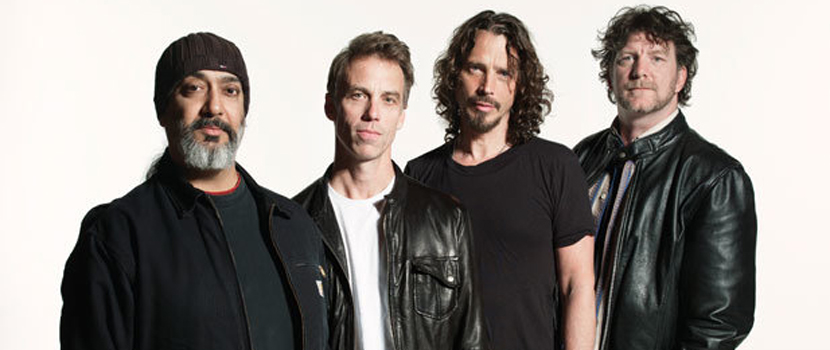
Soundgarden’s Kim Thayil has shared a new excerpt from his upcoming memoir, “A Screaming Life: Into The Superunknown With Soundgarden And Beyond” (out June 9), via Rolling Stone. The piece finds him reflecting on the death of his bandmate Chris Cornell.
Here’s the full excerpt:
“It was just before midnight when I, post-show, went upstairs to the green room to meet some of our guests — two Orioles players and members of Dennis Coffey’s band. I’d mentioned to Chris earlier that they were coming, hoping he might want to say hello, but he had already left the venue. Matt, Ben, and I stuck around, had some beers, and hung out. The night felt off, though. There was something differ-ent about it. Maybe I was still adjusting to Jerome being gone from the tour, or maybe it was the strange vibe Chris had been giving off.
I’d known Chris long enough to sense when something was amiss. It wasn’t just that he was tired—there was something deeper, though he didn’t feel comfortable opening up to me. We weren’t hanging out much during this tour. After sound check, we’d briefly talk about the set, songs we were writing, or ideas we were jamming on. But Chris traveled separately and lived on the East Coast, so we didn’t have much chance to connect outside the band. We’d been apart for years, between 1997 and 2009, and during that time, he’d remarried and moved away from Seattle. So I wasn’t fully in touch with what was going on in his personal life, his sobriety, or how he felt about his career.
In the early hours of May 18, our production manager on the tour, Steve Drymalski, who had taken over for Jerome as tour manager for the final dates, rounded us up to get on the buses to head to Columbus, Ohio. It was a three-hour drive, and we were scheduled to play the following day, May 19, as one of the headliners of the Rock on the Range festival. Matt was on one bus with Steve (which left earlier) and a security person, Ben and I on another with Paul Lorkowski, a longtime band friend and ally who worked as a production assistant, band assistant, and security person. We had a big crew, maybe forty people, including the truck drivers who hauled our equipment and staging. The crew members that weren’t in the semi-trucks were on the tour buses, where they would sleep. We’d been on the road for an hour or two when Matt called me.
“Kim, I’m reading a lot of weird shit on the internet. Somebody posted ‘RIP: Chris Cornell’ on my Facebook page.” That didn’t seem possible to me. We’d just seen him a few hours ago.
“Aw, it’s probably just bullshit,” I told him. I didn’t want to believe anything could have happened to Chris. I woke up Paul — who’d been particularly close with Chris since we reunited — to tell him what was going on. We all got on our phones and computers to see if we could learn anything. It seemed more like a hoax or prank; these kinds of things happen all the time on the internet, where anyone can post anything on social media. Someone’s “joke” goes horribly awry. This wasn’t a joke. Paul finally got confirmation that Chris had died by suicide in his hotel room, not long after the show. I roused Ben to break the news. We still couldn’t believe it, though, like Are you sure? People were panicking and hyperventilating.
***
No one can truly prepare you for dealing with the suicide of a relative or close friend, or even just an acquaintance, but my mother gave it her best shot when I was a kid. Sometimes there are people who are very demonstrative in announcing things, and sometimes they’re drama queens, and they say things to elicit attention and sympathy. My mom had been this way since I was a kid, including discus-sions of suicide with her friends. They’d all be sitting around drinking and talking while I was in the room, maybe age ten or eleven. I was young enough that she should not have been having these kinds of conversations with her son, or her even younger daughter, in the room. But my mom was that way.
It seemed to me my sister had to grow up with a lot of anxiety and fear trying to understand these kinds of statements of suicide from her mom as actual possibilities, which were frightening for a young child to hear. It was pretty frightening for preteen me to hear, too. My stomach would get all knotted with butterflies. These conversations were for her, I’m sure, just matter of fact between her and her friends.
But it wasn’t that way for a kid. I couldn’t imagine or conceive of a life absent my parents, or something inopportune or something violent befalling them. It was frightening and anxiety provoking. But my mom would talk that way, and it was very inappropriate. She con-tinued making these kinds of statements throughout her life: I don’t want to live anyway. The frequency of those statements increased as she experienced her bout with cancer in the nineties. Her doom was imminent, around the corner, and she always made sure that I was aware of that.
Chris never made these kinds of statements to me. I never feared that Chris would harm himself in the way that my mom made me fear as a youth. He was the opposite of my mom. He wasn’t making these proclamations. He never did. Chris’s death and the manner in which he died were so unexpected. It seemed to me at the time to be so out of character in 2017. If Chris had done something like that when the band were younger in the late eighties or maybe even the mid-nineties, on the heels of the deaths of Andy Wood, Kurt Cobain, and Chris’s good friend Jeff Buckley, it might have made more sense. Decades later, at his age, and being a father, it seemed unfathomable. Not in 2017. Maybe in 1997.
I didn’t see it coming. The thing that hurts me the most is to be a close friend and colleague and not to have read things that perhaps, in retrospect, I should have read. That’s hurtful. I feel like I let Chris down by not seeing the look in his eyes, or not hearing a tone in his voice — not being able to read it. But it’s hard to read things like that, because you don’t get a lot of chances at it. You can only look in ret-rospect and go, Ah, here’s an indicator. There was nothing that was on my radar that I could read at that time. And then I looked at the paper trail and it was like Fuck, the paper trail goes back to the be-ginning. His lyrics are just riddled with these kinds of introspective insights. Most of Soundgarden’s work sort of describes something less than sunshiney. That’s what I mean by “paper trail.” This didn’t come out of the blue. I mean, I had conversations with Chris over the years about everything from love, or what is friendship, or death or suicide or the creative process. We were close enough in the early years that we talked about all these things. But talking about these topics wouldn’t necessarily raise alarms or concern. These were just conversations. We were a dark band, and Chris wrote dark lyrics that befit the music. If people think there was something overtly indica-tive in his words, then they have a crystal ball that I didn’t have.
***
In the immediate aftermath of Chris’s suicide, we were fortunate to have good people surrounding us, protecting us, and looking after us. Even though Jerome wasn’t with us, he and Steve worked as a team to manage the situation. Matt, Ben, and I had no idea what we should do. Do we go back to Detroit? To what end?
There was already a media frenzy, and that would put us back in the heart of it. We wanted to avoid the press at all costs. Steve’s suggestion was that we needed to coordinate the crew and the band so we could go somewhere and regroup — easier said than done with that many people and that many vehicles. The band weren’t the only people affected by Chris’s suicide. Every person in our crew was dev-astated. We continued to Columbus and organized a vigil in a conference room of the hotel where we were originally scheduled to stay. The band and crew could be together to weep, grieve, and console each other.
In this period of distress and mourning, all the news and confirmation we received came from our tour manager Steve, the internet, social media, our musical colleagues, and friends back home in Seattle. The only further details we learned much later came from the same mainstream media sources that everyone else was reading. It was a difficult and strange time.
The decision was made that we would continue in the tour buses back to Seattle, although Matt did fly home to be with his wife and young children. The rest of us wanted to avoid plane flights where people may have anticipated what cities we were arriving in or changing over in. The buses also allowed us a certain amount of privacy. We could be in our own grieving world on the multiday trip home. Every one of us, though it surely went unspoken, felt some shame and responsibility. That’s natural. Some were inconsolable, some were in a daze. Some, maybe a day or two later, would start sobbing.
It hit each of us at different times. But eventually, we all found ourselves wondering — was there something we missed? Something we should have noticed, said, or done that might have changed everything?
By breakfast, the beers were already open. Sometimes, some-one would twist the cap off a bottle of vodka. And then the memories would start. It wasn’t a party. It was just one of those strange, in-between spaces where conversation drifted from light banter to heavy silence — until someone finally broke down in tears.
Drinking made it easier to reach our emotions. It softened the edges of grief, helped us move between despair and laughter. Without it, everything felt muted, flat. But with it, we could vent, cry, and — just briefly — laugh again. In sobriety, there was no lightness. But if we drank enough, we could almost feel it. That fleeting brightness, just before the silence returned.”


You must be logged in to post a comment.